



Buying real estate is one of the most significant financial decisions most people will ever make. Yet too many buyers let emotion drive the process, falling in love with a kitchen backsplash or a mountain view while ignoring the metrics that actually determine whether a property is a smart investment. The numbers tell a story. Here is how to read them.
Start With the Price-to-Rent Ratio
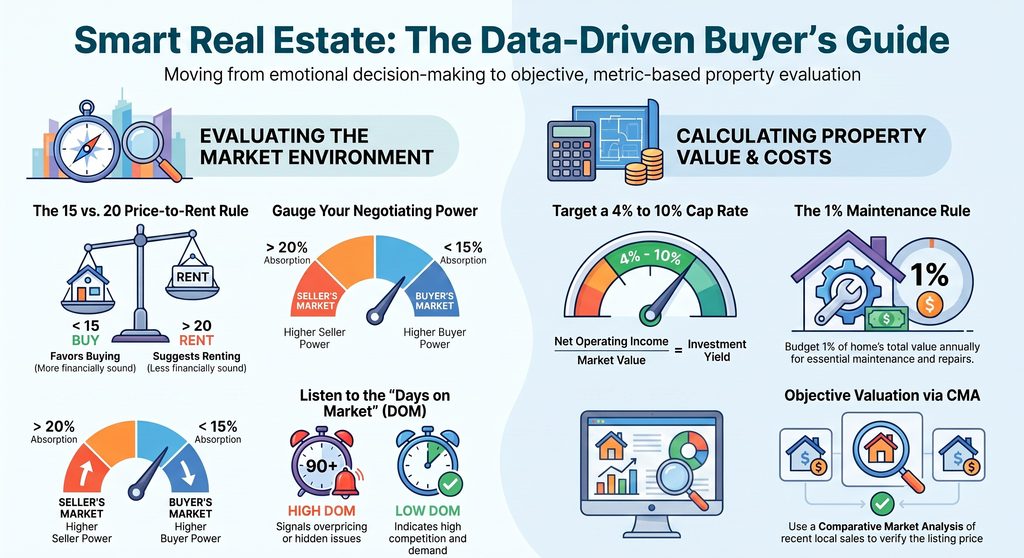
Before you make an offer on any property, calculate the price-to-rent ratio. Divide the home’s listed price by the annual rental income it could generate (or by the annual rent you would otherwise pay). A ratio below 15 generally signals a buyer’s market where purchasing makes financial sense. A ratio above 20 tends to favor renting. This single figure gives you an objective baseline before you ever step through the front door.
Study Days on Market Carefully
Days on market (DOM) is one of the most underused metrics in residential real estate. A property that has been sitting for 60, 90, or 120 days is sending a signal. Either the price is too high for the neighborhood, there is an underlying issue with the home, or buyer demand in that area has softened. Conversely, a home that sells in under a week in a slow market tells you competition is real, and your offer needs to be sharp. Pull the DOM history for any listing you are serious about, and compare it to the neighborhood average.
Understand the Cap Rate for Investment Properties
If you are buying with the intention to rent, the capitalization rate (cap rate) is your most important metric. Calculate it by dividing the property’s net operating income by its current market value. A cap rate between 4% and 10% is typical in most markets, though what counts as “good” varies by location and property type. Urban luxury markets often run lower, while markets in growing secondary cities can yield higher returns. Agents who specialize in investment-focused communities, such as those working in Red Ledges Real Estate, understand how local amenities and lifestyle factors influence these numbers in ways a national average cannot capture.
Look Beyond the Listing Price
The purchase price is only the beginning. Data-driven buyers factor in property tax rates, HOA fees, average utility costs, insurance premiums, and anticipated maintenance expenses. A useful rule of thumb is to budget 1% of the home’s value per year for maintenance alone. When you model all of these costs together, a home that seemed affordable at first glance sometimes reveals itself to be a financial stretch. At the same time, another property priced slightly higher ends up costing less per month once all variables are accounted for.
Track Local Market Absorption Rates
The absorption rate measures how quickly available homes are selling in a specific market. Divide the number of homes sold in a given period by the total number of homes available. An absorption rate above 20% indicates a seller’s market. A reading below 15% indicates a buyer’s market. This metric helps you calibrate your negotiating position before you ever submit an offer, and it changes month to month, so always use recent data.
Do Not Skip the Comparative Market Analysis
A comparative market analysis (CMA) compares recent sales of similar properties in the same area. It is the closest thing to an objective valuation you will get before an appraisal. Review the price per square foot across comparable sales, note how finished basements or additional garage bays affect value in that specific neighborhood, and identify whether the property you want is priced at, above, or below market.
Real estate will always have an emotional dimension. But the buyers who consistently make sound decisions are the ones who let the data lead and let the emotion confirm. Run the numbers first, and the right home will become obvious.